Showing posts with label 1850s. Show all posts

Monday, 27 June 2022

Original Pattern : Chinese collar and Sleeved Talma for a little girl 1857

Two patterns today.  The sleeved Talma looks interesting so I might try making it up for my daughter.  If i do I'll update this page.  In the meantime enjoy these two patterns from Peterson's Magazine 1857.


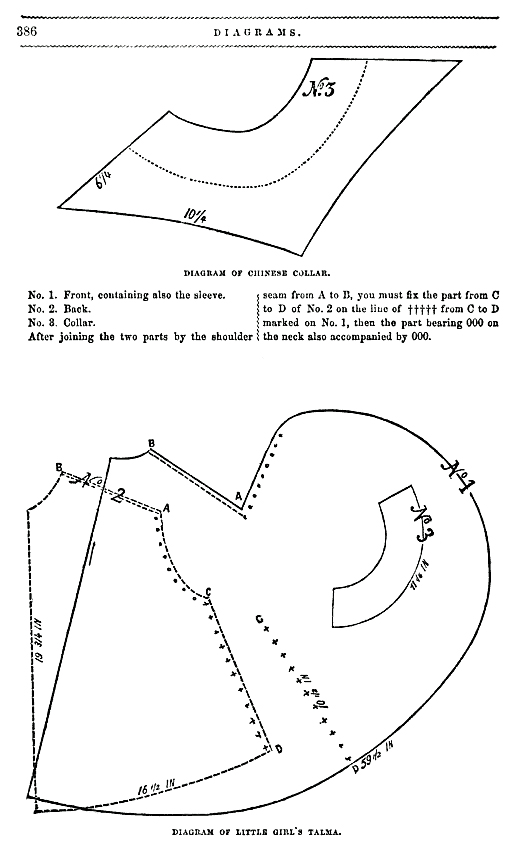
We give, this month, a design for a novel style of collar, called "The Chinese Collar." The annexed engraving shows how it looks when made up. It is composed of two rows of application, and three tufts of very narrow ribbon are put on the front. The diagram, on the next page, No 8, shows how it is to be cut. We also give a diagram for cutting a Sleeved Talma for a little girl of nine or ten years old.


No 1 Front containing also the sleeve. No 2 Back. No 3 Collar. 

After joining the two parts by the shoulder seam from A to B you must fix the part from C to D of No 2 on the line of +++++++ from C to D marked on No 1, then the part bearing 000 on the neck also accompanied by 000.


Sunday, 26 June 2022

Original Pattern : The Algerine Shawl Mantle Peterson's Magazine 1857

I'm planning on putting together a few resources to help make finding original patterns from the 1850s - 1860s a bit easier than having to scan through thousands of pages on online books and other sources. I'll be putting together a couple of pinterest boards on the subject and also sharing many patterns on this blog.  If I attempt to make any myself I'll also share the results :)

This pattern is for The Algerine Shawl Mantle from Peterson's Magazine 1857.

Enjoy!


Our pattern this month for our department "How To Make One's Own Dresses" the is Shawl Mantle, the prettiest affair which been produced, this season, in Paris. It is extremely easy to be made; and comparatively economical also. It is made of black taffetas. The form is half square, hollowed to the form of the neck, with a small plait taken out at the neck on each side, to make it fit well on the shoulder. On the taffetas, at equal distances, are rows of guipure insertion with narrow waved stripes of velvet woven in it; it is called velvet guipure: the taffetas is cut from underneath, leaving the insertion transparent; at each side the insertions are finished with a narrow guipure edging, lightly ornamented with jet. The rows of insertion are so arranged as to give the appearance a square shawl; the edges are trimmed with fringe of silk and jet; a second row of fringe is on in the middle of mantle, where the insertions are reversed. On the next page we give a diagram by which mantle may be cut out. The three pieces of which the pattern consists is half the mantle; manner of joining them together is indicated by cuts in each piece, which are to be placed opposite each other; for instance, the two pieces which have one cut in them must be joined together; this part forms the front of the pattern; the bottom must have a corner joined on, of the same size and form as marked by the pricked line. The smaller piece, which forms the corner at the back of mantle is indicated by two cuts, which must be joined to the two cuts at the back of the mantle; this completes the pattern. This would be a very good pattern for a plain velvet shawl, or may be trimmed in various styles.


Saturday, 25 January 2014

Up close and personal - Early 1850s peplum bodice


Welcome to the second "up close and personal" blog posts where I get up close and personal with some of the items in my collection.  Today is this lovely beige moire silk c.1853-55 peplum bodice.  I purchased this beauty from the lovely L.Hidic at CorsetsandCrinolines and she in turn had bought it from a dealer who had let his daughter's pet rabbit munch on the back peplums :(  Anyway, on with the photos!


Please excuse my dress making dummy and she's a little too well proportioned for this bodice.  If i ever get a chance to model it on a smaller one I'll retake the photo.  In the meantime you can see how it looks fastened here on the previous owners website.  As you can see it is a beautiful v-necked bodice designed to be worn over a chemisette.  The bust measures 32" and the waist 24 1/2".


The sleeves are made from three pieces, the first straight, the second double ruched then the last being the bell sleeve.  


The bodice has lovely blue and white trim and pale yellow (rather than discoloured) and dark blue fringe.


The v-shape of the neckline is mirrored by the addition of two pieces that run from the waist at the front, across the shoulders and to the back.  The join in hidden by the trim.  Peeking underneath we can see the true colour of the bodice which is a little more pink than what we see today.  We can also see from these photos that the peplums were cut as part of the bodice and not added separately.  Both the v-shape and the peplums help to show off the already very tiny waist.


On to the inside of the bodice now.  Here you can see the design of the bodice more clearly without the distraction of all the trim.  Please ignore the dark line going down the center back, it's unfortunately damage due to it being stored folded at some time.


The peplums have not been lined.  Rather cleverly the maker has turned the seam allowance towards the fashion fabric and then hidden it with the trim (on all but the front two peplums that have been seamed in the normal fashion).  


The main bodice is lined in cotton, is not boned and is completely hand sewn.


The sleeves have been lined in two separate sections with the bottom unlined.  The first is very loose weave and soft with no real body, the second to which the ruching is secured is again very loose weave (see close-up) and feels like stiff organdy.  The bottom of the sleeve has been cut on the selvedge edge.


The bodice fastens at the front with three brass hooks and eyes.  There are also two pieces of tape sewn at the front just at the bottom of the hooks and eyes.  The first is wider and sewn doubled up, the second is thinner and single thickness and may have been longer as the edge is frayed.  If anyone knows what these mysterious bits of tape are for please let me know.  I have a slightly older 1850s basque bodice that has cotton ties coming from the inner back waist with a hook and eye to secure the bodice at the front but those point sideways whilst these ones are pointing downward so it doesn't really make sense for them serve the same purpose.  I can only wonder if the cotton tape on this bodice had something to do with keeping the skirt and bodice from separating?  


That's all the photos of this bodice for now.  I have two more basque bodices that will feature in the future, one from the late 1850s and the other from the early 1870s.  I've also a couple of articles in the works and I will finally put together and photograph my knitted scarf!  Please follow this blog to get updates and/or join us on facebook where I post updates on this blog as well as lots of Victorian and Regency eye candy :)

Sunday, 4 August 2013

Mid victorian ambrotype and some photoshop fun :)


Two weeks ago I picked up a lovely mid-victorian ambrotype from a local antiques fair.  I noticed immediately that her broach and belt had been coloured, but it was only after I put the photograph under the scanner and viewed it on the screen that it became apparent that the drapes, background and her cheeks had also been tinted.  I've also been having some fun with photoshop and colourized the image. The lips could have been a better shade (if i hadn't stopped tweaking the image now i would have gone on forever) but i think seeing her in colour really brings her to life.  I love the dress and would be tempted to have a go at recreating it one day.  I'm sure i've got some fabric in my stash that would work :D


Outer case

Inner case


Original scan

Tweaked in photoshop with a little bit of cleaning up

Close up 1

Close up 2

Colourized in photoshop


Friday, 24 May 2013

Celebrating the anniversary of Queen Victoria's Birthday. Images of Englands virtuous Queen.


Today (May 24th) marks the 194th anniversary of Queen Victoria's Birthday.  It always saddens me how often I see Victoria portrayed as the stereotypical post Albert old lady in black, especially during events that are aiming at the era before Albert's death (pre 1861).  So to celebrate her birthday here are my favourite images of Queen Victoria during her heyday, from the beginning of her reign at the age of 18 to the death of her beloved Albert in December 1861 when she was 42.


 Queen Victoria c.1839


Queen Victoria by John Partridge 1840 the Royal Collection


 Queen Victoria, Henry Pierce Bone, 1840. Photo: Royal Collection


 Queen Victoria (Alexandrina Victoria) (1819-1901) by Charles Brocky in 1841.


Queen Victoria, William Essex, 1841. Photo: Royal Collection.


Queen Victoria
by Mrs Edwin Dalton (Magdalena Ross), after Sir William Charles Ross
lithograph, 1843


Queen Victoria (1819-1901) by Robert Thorburn in 1844


Queen Victoria (1819-1901) by Franz Xaver Winterhalter in 1845.
The Royal Collection


 Queen Victoria by unknown artist. 1840s.


  Queen Victoria 1845


 Queen Victoria 1847  Franz Xaver Winterhalter


Queen Victoria with Prince Arthur 1850 Franz Xaver Winterhalter


  Queen Victoria, 1850s. 


The Cousins: Queen Victoria and Victoire, Duchesse de Nemours by Franz Xaver Winterhalter 1852
wikipaintings


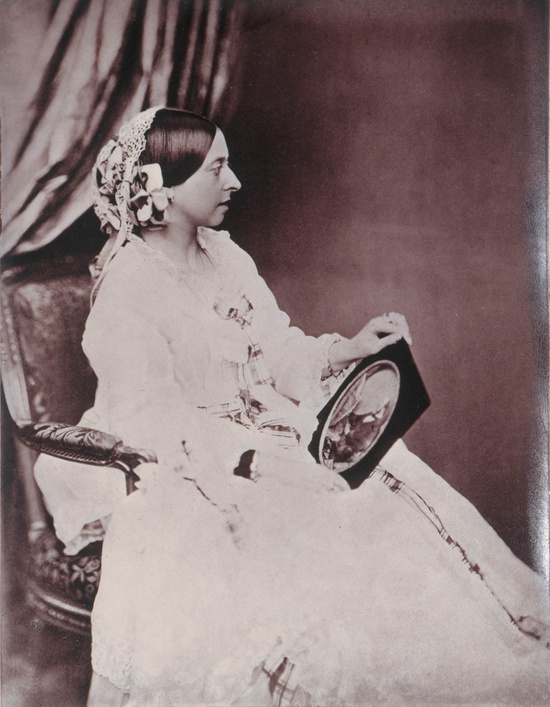
 5th July 1854 Photograph showing a three-quarters length right profile portrait of a seated Queen Victoria at Buckingham Palace. She rests a photographic portrait of Prince Albert on her lap. In July 1854, Queen Victoria commissioned Duppa to take a photograph of her, as a surprise for her husband. The portrait shows the Queen holding a framed copy of a portrait of Prince Albert taken by the same photographer a few months earlier.
The Royal Collection


  Queen Victoria photographed in her wedding gown by Roger Fenton in 1854


 Queen Victoria 1855 Franz Xaver Winterhalter


 Queen Victoria 1856 by Charles Lucien Louis Muller.


Handtinted image of Prince Albert and Queen Victoria c.1850s


 Vicky with Victoria 1857


 Queen Victoria c.1850s


 Queen Victoria and Prince Albert, ca 1860


1860 Queen Victoria by John Jabez Edwin Mayall (The Royal Collection)


Queen Victoria with Princess Beatrice c.1861


 Queen Victoria by John Jabez Edwin Mayall 1861


 Queen Victoria via Grand Ladies